Compare commercial wallcovering for restaurants across dining, bar, service and retail zones, with selection advice on spills, cleaning and maintenance.
The most durable commercial wallcovering for restaurants is not one universal product. It is an assembly — face material, backing, adhesive and installation detail — matched to the wear, cleaning and moisture conditions of a specific zone.
A finish that survives a dining room can fail behind a bar; durability belongs to the zone, not the pattern.
Dining rooms punish finishes with chair backs, table edges and wiping cloths. Bars punish them with splash, syrup, sanitiser and corner impact. Service corridors and retail floors add trolleys, stock movement and constant spot cleaning. Decorative wallpaper is not automatically waterproof, washable or suitable for kitchens, so ask for product-specific evidence before approval.
Key Takeaways
Specify wallcovering by zone: dining, bar, service corridor and retail each carry different traffic, spill and cleaning profiles.
A moisture-resistant face material does not make the installation waterproof — backing, adhesive, seams and edges decide.
Decorative wallpaper is not automatically washable; confirm written cleaning instructions and test a sample before ordering.
Approve corner mock-ups under project lighting, because seams and cut edges fail before the face does.
Unit price does not predict lifespan; cleanability and repairability drive the real replacement cost.
Commercial Wallcovering for Restaurants: Durability Starts with the Location
Location decides durability. The same wallcovering can be sensible on a dining-room wall and unsuitable behind a bar, in a service corridor or beside a kitchen entry.
Splash, cleaning chemistry and furniture edges all attack the weakest point of the assembly: the seam, the cut edge and the substrate joint. A chair back loads a small patch thousands of times per month, while steam and sanitiser reach the same joints from the outside.
Published test methods separate scrub resistance, coating adhesion and abrasion into different procedures, and each one tests a flat specimen rather than a seam on a real wall (ASTM International). That gap is why site failures cluster where no flat specimen exists.
Dining Areas, Bars, Service Zones and Retail: Key Differences
Each zone weights the requirement differently. Dining areas reward washable, scuff-tolerant surfaces; bars reward moisture control at seams and counter junctions; service zones reward impact tolerance and fast repair; retail rewards scrubbability under daily spot cleaning.
Dining Areas: Furniture Contact and Routine Cleaning
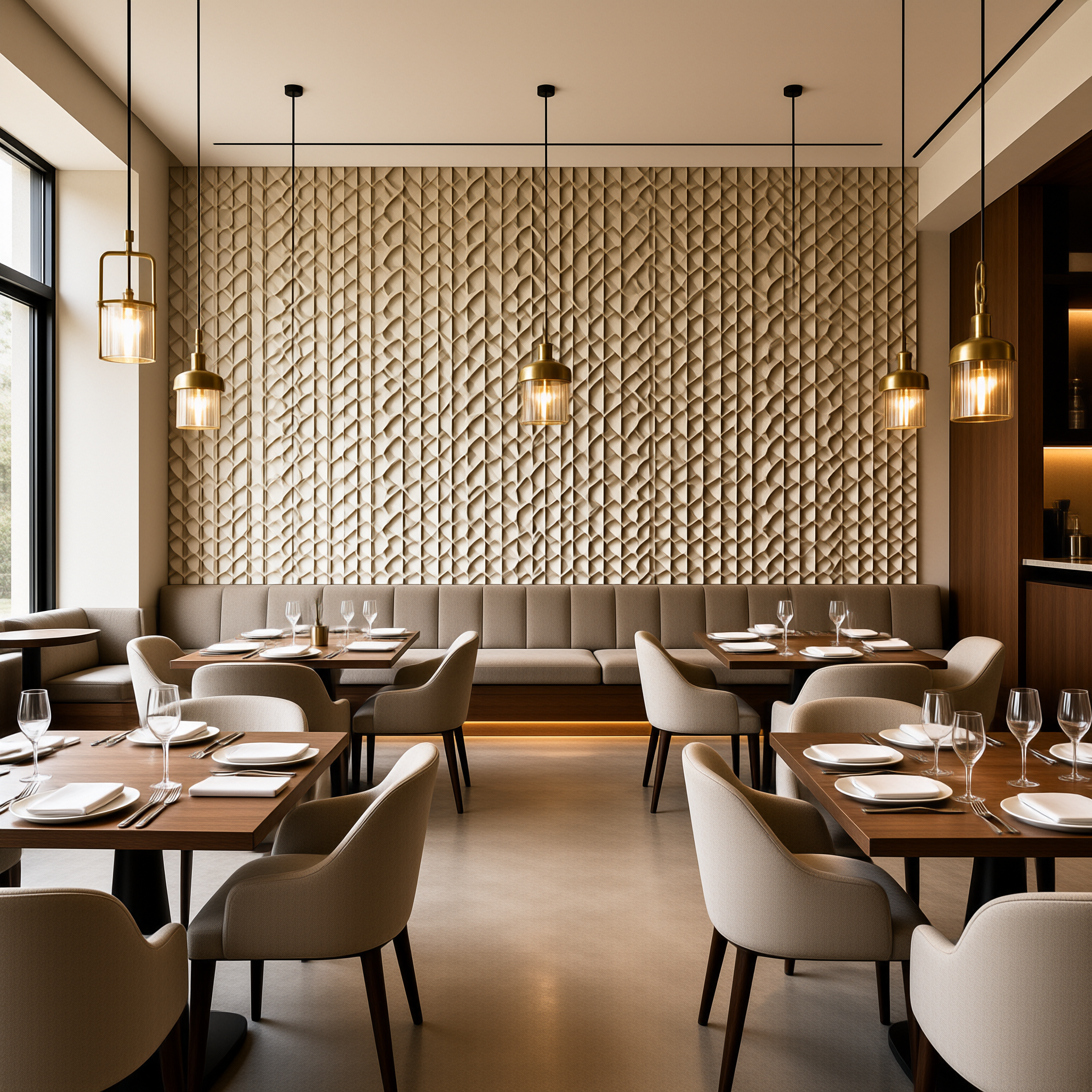
Seating backs, table edges and stacked chairs create most dining-room wear. The specification priority is a surface that tolerates repeated wiping, plus a seam layout that keeps joints out of the contact band.
Washable commercial wallpaper for restaurant dining areas should be confirmed as a complete system, not as a face material alone. Ask whether the adhesive and the installed seam tolerate the cleaning agent your staff already use.
Restaurant wallpaper printed on a decorative base is a common specification here, and it is also a common source of disappointment when washability was assumed rather than documented. The tradeoff is print choice against cleaning evidence.
Bars: Splash Exposure and High-Touch Corners
Bars concentrate risk into small areas: the counter face, the back-bar wall, the corner where staff turn with glassware, and the lower wall in the floor splash zone.
Specify these walls by joint behaviour rather than by pattern. If a seam sits inside a splash path or a wipe-down route, the finish will be judged by that joint, not by the printed surface.
Service Zones: Traffic, Moisture and Fast Maintenance
Service corridors and pass-through walls take impacts rather than stains. Trolley corners, door frames, bin lids and cleaning carts strike the same 0.7–1.1 m band every shift.
Repairability matters more here than a seamless look. A coordinated panel that can be replaced in an hour usually beats a finish that must be patched across a full wall.
Retail: Customer Contact and Display Surfaces
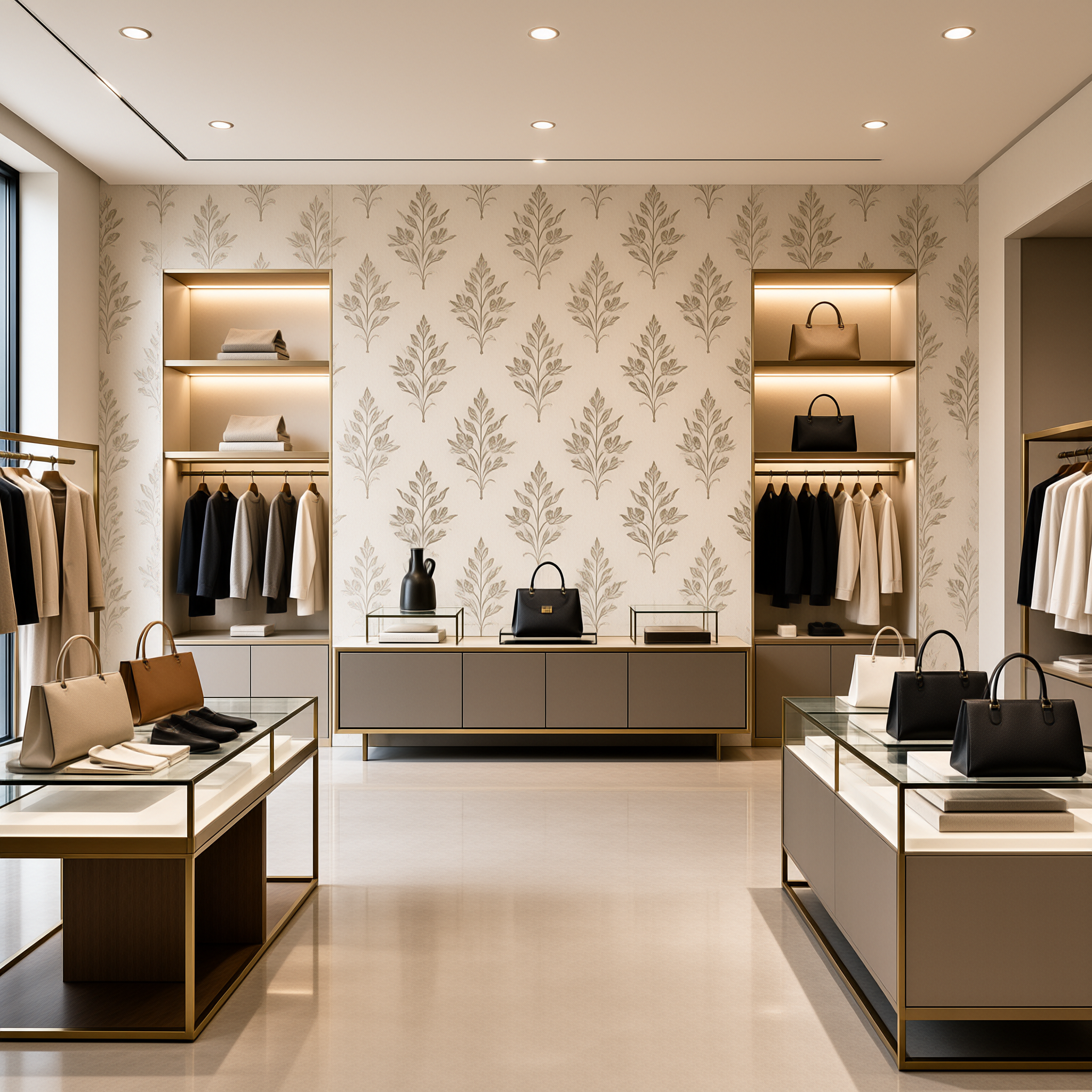
Retail sales floors combine customer contact, stock movement and quick spot cleaning under display lighting. Marks appear in daylight that nobody sees in a sample folder.
Fitting rooms, queue zones and shelf-end walls behave differently from a quiet perimeter wall. Treat the queue zone as a contact area and the perimeter as a low-contact area, even inside one shop.
| Zone | Dominant wear | Moisture exposure | Cleaning demand | Specification priority |
|---|---|---|---|---|
| Dining area | Chair backs, table edges | Low, apart from spill wipe-up | Routine wiping | Washable surface, repairable panels |
| Bar | Counter face, corners, glassware contact | High: splash, condensation, spirits | Frequent wipe-down | Sealed edges, compatible adhesive, moisture detail |
| Service zone | Trolleys, door frames, cleaning carts | Medium: spills, damp equipment | Heavy and fast | Impact tolerance, spare stock, quick repair |
| Retail floor | Customer contact, stock movement | Low to medium | Daily spot cleaning | Scrubbability, mark hiding, repair access |
Traffic, Furniture Contact and Wear: What to Specify
Specify for contact wear first, appearance second. A high traffic commercial wallcovering is judged at chair-back and trolley height, not by how it photographs.
Contact wear is a point load repeated in one place. A chair back scuffs the same 200 mm patch every service, and the substrate behind it flexes slightly, so the coating fatigues before the print fades.
Damage records in contact-area reviews concentrate between 0.7 m and 1.1 m above finished floor — the height of chair backs, trolley corners and mop handles (internal observation, 4-zone project review, measured damage mapping). Belts, bags and cleaning cloths concentrate higher, around 0.9–1.3 m.
Most wallcovering damage sits in a 0.7–1.1 m band — chair backs, trolley corners and cleaning equipment.
Spills, Moisture Exposure and Cleaning Demands
Moisture and spills usually defeat an installation at its joints, not its face. Bar wallcovering selection should start at the seam, the cut edge and the counter junction.
Liquid wicks along a seam by capillary action and reaches the adhesive line. Repeated dampness softens a water-based adhesive, the edge lifts, and the next cleaning pass pushes more moisture behind the sheet.
Reported failures in splash zones cluster at four points: a seam within 300 mm of a sink or glasswasher, an unsealed cut edge, an adhesive not specified for the substrate, and cleaning agents outside the written instructions (internal observation, cleaning-method review, 3 sample groups per zone).
Seam position relative to sinks, glasswashers and ice wells — keep joints out of the direct splash path.
Edge sealing at counter tops, backsplashes and door reveals, where water collects.
Adhesive and substrate pairing, confirmed in writing for the actual wall build-up.
The cleaning agents and frequency your team will really use, compared against the supplier's instructions.
A repair plan and spare material for the highest-risk panel, not the whole room.
Retail Wallcovering: Customer Contact, Stock Movement and Daily Cleaning
Retail wallcovering choice splits on three dimensions: scrubbability, mark hiding and repair speed. Flat and dense wins for cleaning speed; deeper texture wins for hiding contact marks.
Deep embossing hides scuffs by breaking up reflected light. However, the same relief traps dust and needs brushing as well as wiping, so staff time rises while visible marks fall.
A scrubbable wall covering for retail stores earns its cost where staff clean daily without supervision. A decorative print can still suit a low-contact fitting-room wall, provided nobody expects it to survive trolley traffic.
Flat dense surface — fastest to wipe, shows scuffs clearly between cleans.
Shallow texture — balanced cleaning speed and mark hiding, good for queue zones.
Deep embossed — best mark hiding, slowest to clean and dustiest in service areas.
Fabric-backed build — warmer acoustics, slower to dry after a spill or wash-down.
How to Specify Wallcovering for Each Commercial Area
Specify by zone, then by assembly. Three checks — exposure mapping, complete performance claims and a sample-based maintenance plan — remove most of the risk before purchase orders are raised.
Map the Exposure
List every wall, not every room. One dining room can contain low-contact decorative panels, a chair-back contact band, a service door reveal and a counter front.
Rate each area for traffic, furniture contact, splash and cleaning frequency, then assign a finish class to each rating. One product for a whole venue is the most common specification shortcut and the most expensive one.
Verify the Complete Performance Claims
Ask what was tested: the face film, the coated fabric, or a full installed assembly. A durable commercial wallpaper claim means little if the adhesive and the seam were left out of the test.
Ask for the method name and year, not only a pass mark. ASTM International publishes the abrasion, adhesion and scrub procedures buyers usually reference, and the method tells you what the number actually measures.
Sample the Installation and Maintenance Plan
Approve a mock-up, not a swatch. A one-square-metre corner panel shows the seam, the cut edge, the sheen under project lighting and how the print repeats across a joint.
For a mixed dining and bar fit-out, VELORA maps each proposed finish to 4 exposure zones — seating backs, bar counters, service corners and customer-facing walls — then records the agreed cleaning method and repair note for each zone. The exercise takes hours and prevents one finish from being assumed suitable across all 4 (1 mixed-use project, 4 exposure zones, zone mapping and written finish schedule).
| Zone | Dominant risk | Specification priority | Common mistake |
|---|---|---|---|
| Dining area | Chair-back and table-edge scuffing | Washable face, repairable panels | Choosing print before checking the cleaning agent |
| Bar | Splash at seams and counter junctions | Sealed edges, compatible adhesive | Assuming a moisture-resistant face seals the wall |
| Service corridor | Trolley and door impact | Impact tolerance, spare stock | Ordering exact quantity with no repair material |
| Retail floor | Customer contact and daily wiping | Scrubbability, mark hiding | Skipping the scrub and repair test after approval |
| Decide by exposure, not by price. If a zone is wiped more than twice per shift, choose a finish whose written instructions name that cleaning agent. If the wall sits below 1.5 m in a contact band, choose repairability over pattern. A durable commercial wallpaper specification earns its cost in the contact band and the splash path, rarely in quiet corners. The tradeoff is upfront cost against replacement frequency. |
Maintenance, Installation and Common Procurement Mistakes
Most wallcovering failures are installation and maintenance failures. Substrate preparation, adhesive choice, seam work and cleaning discipline decide the outcome more than the pattern does.
A damp or contaminated substrate stops the adhesive bonding evenly. The panel looks correct on day one, then lifts at the seam where the bond was weakest — usually the first place it gets wiped.
A practical VELORA review protocol screens 3 sample groups from each application zone: one for appearance and seam continuity, one for cleaning-method compatibility, and one for edge, corner and furniture-contact wear. Each candidate is documented against the supplier's care instructions before full-room approval (3 sample groups per zone; documented visual, cleaning-method and contact-area review).
Approving a swatch instead of a corner mock-up — seams and edges fail first.
Ordering exact area with no repair stock for the highest-contact band.
Assuming restaurant wallpaper is washable without a written cleaning instruction.
Switching adhesives between zones, then losing the product-specific warranty terms.
Hanging before checking substrate moisture and surface contamination.
Commercial Wallcovering FAQ
- Is decorative wallpaper suitable for restaurant kitchens and service zones?
- Not by default. Decorative wallpaper is not automatically waterproof, washable or appropriate for kitchens; require product-specific evidence and compatible installation details.
- Which wallcovering is best for high-traffic restaurant dining areas?
- One whose full assembly — face, adhesive, seam and edge treatment — documents wear resistance, cleanability and furniture-contact performance for that contact band.
- Can bar wallcovering handle frequent spills and cleaning?
- Often yes, but only where the documented cleaning and moisture performance suit the location. Edges, corners, seams, backing and substrate preparation need separate attention.
- What should a buyer request before ordering retail wallcovering?
- Material construction, cleaning instructions, relevant test information, finish samples, seam and mock-up approval, roll lengths and quantities, plus installation and maintenance terms.
- What causes commercial wallcovering to peel or stain?
- Moisture migration, incompatible adhesive, poorly prepared or contaminated substrate, and cleaning beyond the written instructions are the usual causes.
- Does commercial wallcovering for restaurants always cost more than decorative wallpaper?
- Upfront cost is often higher, but compare cost per year in service — cleaning labour, touch-ups and replacement panels — rather than price per roll.
Durability is decided by the zone, the assembly and the cleaning protocol — rarely by the pattern.
For a venue that mixes dining, bar, service and retail areas, commercial wallcovering for restaurants should be specified zone by zone, with samples, cleaning instructions and repair stock agreed before the first roll is ordered. Teams that document those decisions once tend to avoid re-specifying the same wall two years later. The logical next step is a written zone schedule, supported by the test method references published by ASTM International.